The Hidden Cost of “Pay to Play” Marketing in eCommerce
Small eCommerce sellers are being pushed into “pay-to-play” marketing across platforms like eBay, Etsy, and Shopify. Learn how to control ad spend, test effectively, and protect your margins with data-driven decisions.

And How Small Businesses Can Take Back Control
The Reality No One Wants to Say Out Loud
There has been a very clear shift in eCommerce over the last few years:
👉 Platforms are no longer just marketplaces.
👉 They are becoming paid marketing ecosystems.
For small business sellers, this creates a dangerous cycle:
- Spend more to get visibility
- Accept lower margins
- Work harder for the same (or worse) results
And the expectation?
Keep spending.
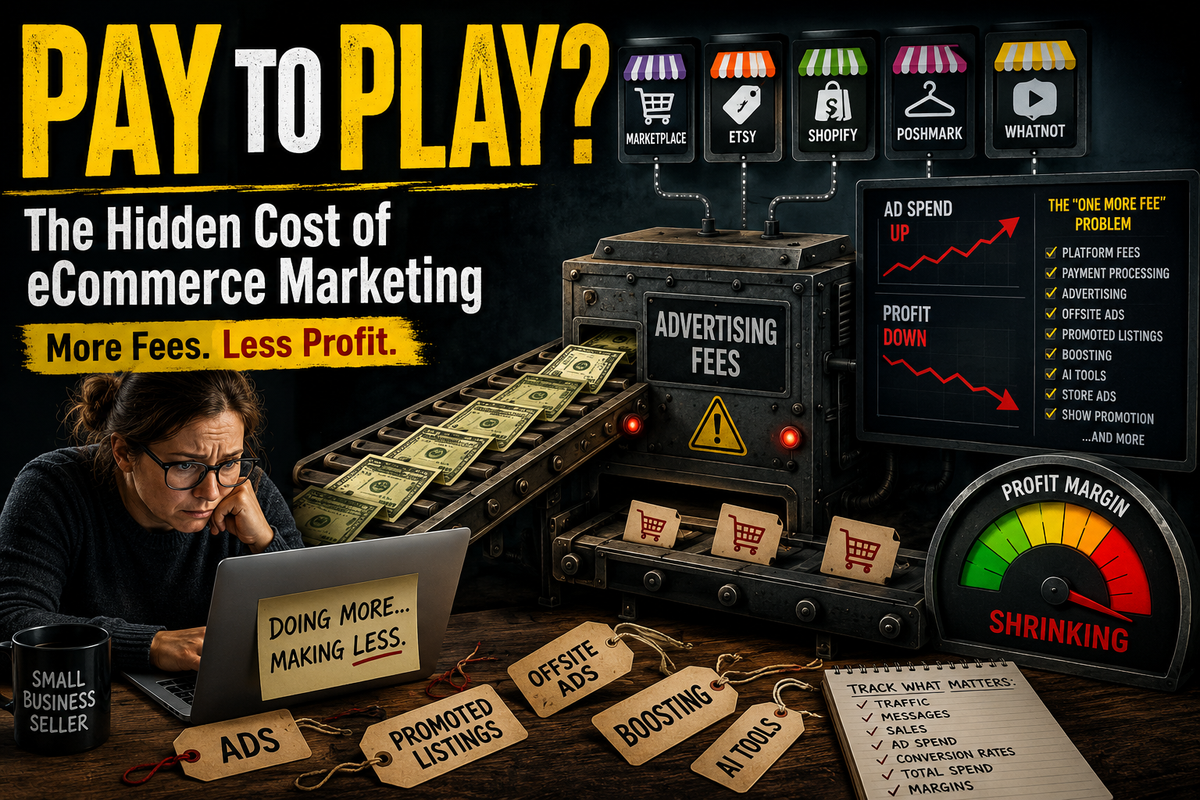
The “One More Fee” Problem
Across every major platform, the pattern is the same:
- eBay pushes promoted listings, store ads, and offsite ads
- Shopify introduces AI-driven marketing tools (paid, of course)
- Etsy layers in offsite ads and increased fees tied to your own traffic
- Poshmark promotes “closet boosting”
- Whatnot encourages paid show promotion
Individually, each fee feels small.
Collectively?
They become margin killers.
What This Actually Does to Your Business
Let’s strip this down operationally.
When you increase spend without structured testing:
- Your cost per sale increases
- Your net margin shrinks
- Your sell-through rate doesn’t necessarily improve
- Your decision-making becomes reactive instead of strategic
This is where many small sellers get stuck:
“I’m doing more… but making less.”
That’s not a marketing problem.
That’s a systems problem.
The Moment You Need to Say STOP
At some point, every seller hits this threshold:
“How much of this sale am I willing to give away?”
If you don’t define that limit, the platforms will define it for you.
A simple rule:
- Set a maximum allowable total fee percentage per item
- Include:
- Platform fees
- Payment processing
- Advertising spend
If the total exceeds your threshold → you do not scale that method
So What Should You Do Instead?
This is where most advice falls apart.
“Just market better” is not a strategy.
What you need is controlled testing.
A/B Testing: Not Just for Big Brands
If you sell repeatable products, A/B testing is straightforward:
- Same item
- Different ad strategies
- Clear comparison
But most small sellers — especially vintage and thrift — don’t have that luxury.
So what’s the workaround?
You test like-for-like categories:
- Vase vs. vase
- Pendant vs. pendant
- Mug vs. mug
Is it perfect data? No.
Is it directional and useful? Absolutely.
Over time, patterns emerge:
- Which categories respond to ads
- Which platforms convert better
- Which spend levels are sustainable
What You Should Be Tracking (Non-Negotiable)
If you are spending money, you should be tracking outcomes.
At minimum:
- Traffic (views)
- Questions/messages
- Total sales
- Ad spend per item or campaign
Additional tracking options:
- Click-through behavior (categories/sales, you are looking for patterns)
- Conversion rate
- Total sales per venue
- Sales yr/yr
- Total spend per venue
Without this?
You’re guessing.
Be sure to follow for more information for small businesses on Customer Service, eCommerce, and Marketing for both (even with AI!)